Counting the Enslaved Population
Most of us are familiar with the 1850 and 1860 Slave Schedule of the U.S. Census, but did you know that the enslaved were counted much earlier? Starting in 1820 the enslaved population was counted, giving the age range and sex of each individual.
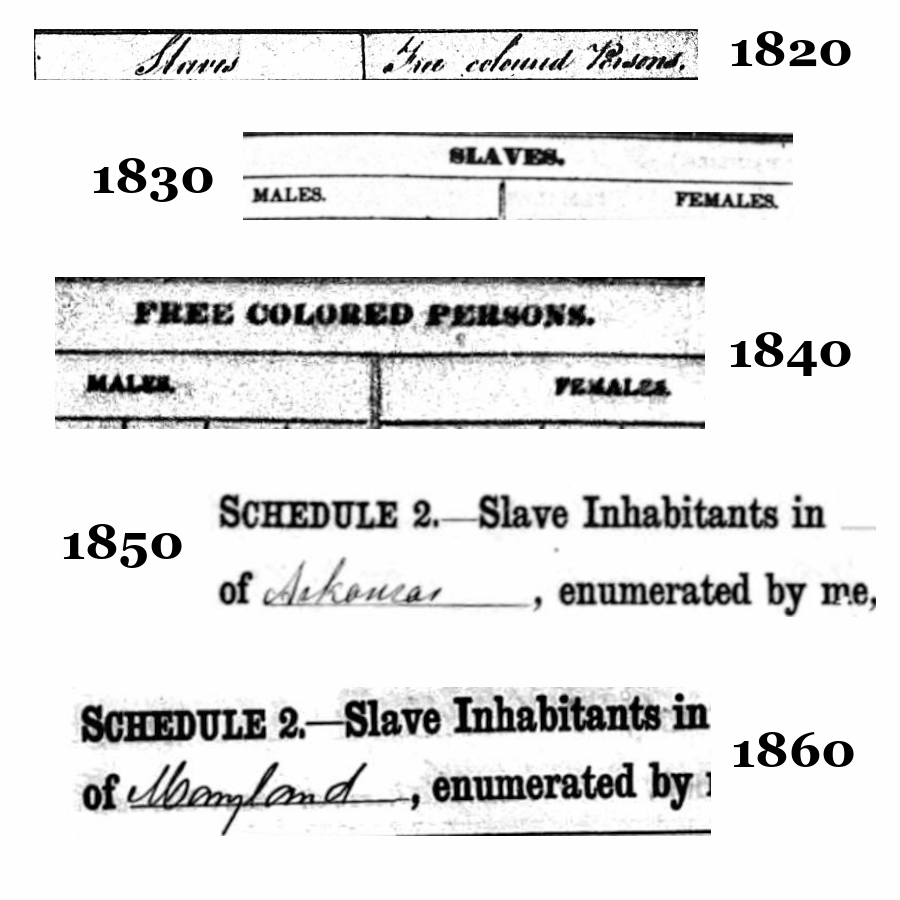
The number of slaves a person owned has been counted in every census until slavery was abolished. In 1790, 1800, and 1810 the last column on the census was how many slaves were in a person’s household. Starting in 1820 and continuing until 1840, free and enslaved black people were counted.
Like the rest of the population, their ages were recorded as age ranges instead of a specific number, but using the technique we talked about in The Math Can be Tricky you can get close to the age of your black ancestors.
Comparing Censuses
Once armed with that information there are a few things you can do to help further your research. If they were enslaved the 1820-1840 census will list the names of their owner. You can go forward to the 1850 and 1860 slave schedules to get their exact age if they were still living.
You can also check the probate records of their owners. If their owner died while they were still enslaved, most of the time the will or other probate documents will list them by name and age. You can also determine who were their new owners, helping you identify them after emancipation.
If the first time you find your black ancestors is on the 1870 census there are a few other research tools you could try. Look at the pages before and after them in the 1870 census for large landowners, with at least several thousand dollars in real estate. If you find one, try to find that same person in the 1860 census. Once you find them in the population schedule, go to the 1860 slave schedule to see if they owned any slaves. If they did, and they are ten years younger than your ancestors on the 1870 census, then they might be your ancestors.
Surname the Same?
Another thing you might try is looking in the 1860 census in the same county or location for large landowners with the same surname as your formerly enslaved ancestors in the 1870 census. Most enslaved people did not have a surname and may not have remembered the surname they had at birth. They would often take the surname of their former owners, especially if they were treated well as slaves. If you find a similar name in the 1860 census, check the 1860 slave schedule to see if that person owned any slaves. If they had one that was ten years younger and the same sex as your ancestor in the 1870 census, again you may have possibly found your enslaved ancestor.
Not Proof, Just a Hint
Be aware that the above two techniques are not proof of a relationship, but rather a coincidence that requires further research.
Like many other things in the census, what we’ve discussed tells us some things and gives us hints where to research more. If we can help you discover your ancestors, drop us a line.
We’d love to know what you think! Please leave a comment below.
Subscribe to this blog by filling out this simple form: