Your Ancestor’s Name … Maybe!
The first major column in the census, and arguably the one our eyes are first drawn to, are the names. Ideally these names would be the proper names of our ancestors, would be spelled correctly, and would be legible. Unfortunately that is often not the case.
19th Century Literacy
Literacy in the U.S. has always been relatively high, but until the 20th century it was high mainly in white populations. African Americans who were enslaved or recently freed typically had low literacy rates, and immigrants had to learn a new language. A National Assessment for Adult Literacy reports that in 1870 the white population of the U.S. was 80% literate, while all other ethnicities were only 20%.
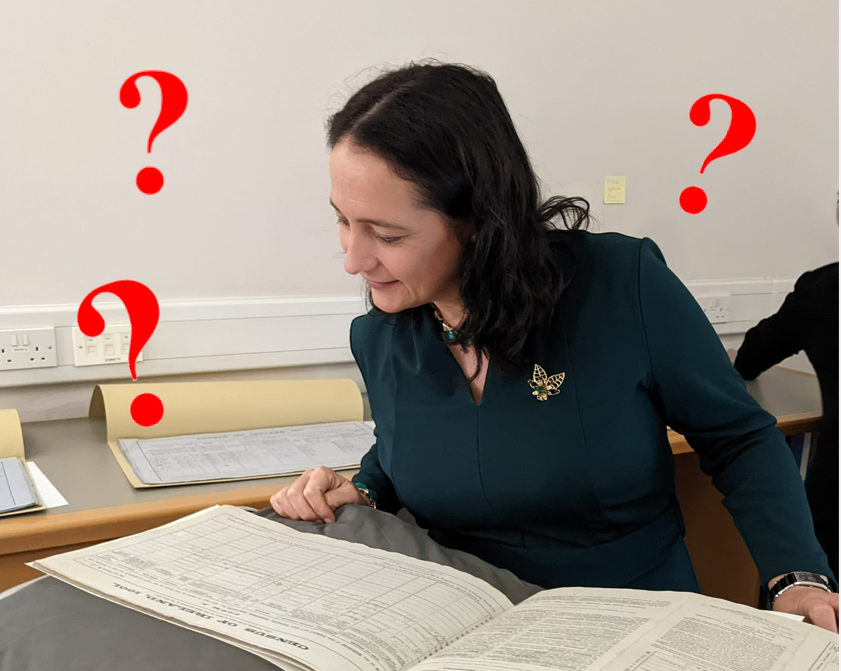
What this means for us is that when the census enumerator called on your 19th century ancestor, there was a pretty good chance that they could not read or write English. As a result, the interviewer would often write down what they heard. If your ancestor’s name was Jaime, the census enumerator might very well record it as Hime if no one was there to give them the correct spelling.
AI Does Its Best
While online databases today are very good at automatically suggesting spelling variations, they are not perfect. If your recent immigrant ancestor with a thick accent had the name Jamison, it could easily have been recorded as Jason. That would be a difficult leap for any computer to make.
You can overcome this by searching for any variation of your ancestor’s name you can imagine. If you don’t find your ancestors where you expect them to be, don’t be afraid to read through the census for that county to look for them. Besides looking for unusual spellings of their names, it is important to realize that the census records we are looking at online are not the original record but copies that were made to send to the federal government. As you are aware, any time you make a copy mistakes can occur. Reading through a hundred pages of the census may sound like a daunting task, but in reality it will only take a few minutes, and if you find your missing ancestor it will be worth the time!
Thinking Outside the Box
The key to finding those difficult to find ancestors in the census is creativity. Think about what variations in their name could have been recorded and search for those as well. If don’t have any luck, read the entire census for that county. It will go faster than you think. Trust me, I do it all the time. Besides, it’s a great way to practice reading handwritten manuscripts!
At Heroes of the Past we have read through hundreds of pages of the census. If life is pulling you in too many directions, we would love to help you tackle the census and find those elusive ancestors. Contact us today to get started!
We’d love to know what you think! Please leave a comment below.
Subscribe to this blog by filling out this simple form:






I am not very excellent with English but I find this rattling easygoing to read .
Regards for this grand post, I am glad I noticed this site on yahoo.
I hope it helps in your family history research!
I enjoy, lead to I found exactly what I was looking for. You’ve ended my 4 day long hunt! God Bless you man. Have a nice day. Bye