First Things First
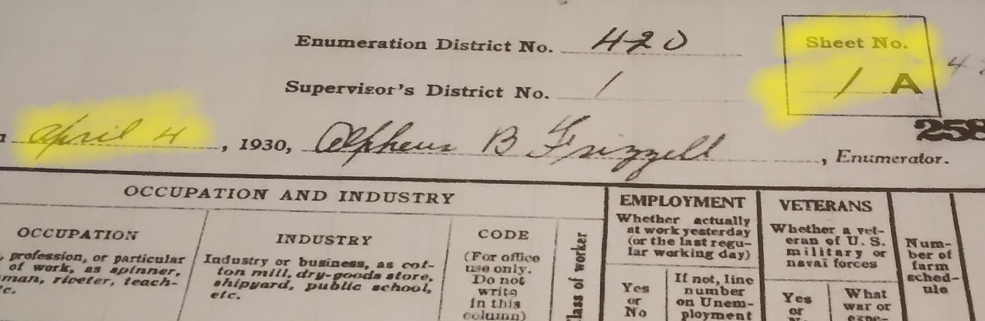
Before we jump into the body of the census let’s look at other information on the outside of the body of the census, the heading. The heading contains some information that will help you better understand what is contained in the body of the census. One of those is the date.
When Did it Happen?
The date the census was taken was required on all the censuses, even the 1790 census. I am not talking about the census effective date, like June 1 or April 15, but the date the information was actually recorded.
It is easy to imagine a census enumerator walking door to door with the population schedule and recording information about each person in their district. What really happened is that each enumerator many different censuses with them. They all had the population schedule, but depending on the decade, where their district was, and other factors they may have also had the agricultural schedule, the mortality schedule, the business and industry schedule, or other special schedules that were required in different decades. If you are trying to find your ancestor’s on a non-population schedule, the date can be an important tool. Once you find your ancestor on the population schedule you can match the date with another schedule, like the agricultural or mechanical, to make sure it is your ancestor.
Your Number Please!
Another helpful item in the heading is the page number. Not necessarily the one that was stamped but the one that was written when the page was originally copied. Sometimes it is called a sheet number. In an effort to make things easier for us, the people who organize and provide these records for us sometimes group them into counties or towns. Most of the time that is awesome, but occasionally enumerators would cross county or town borders. If you think your ancestor lived in a place and you are reading through that census, and the last page is a full one, look around in the neighboring communities or even counties to see if another group starts with the next page number.
I guess this is as good a time as any to remind ourselves that census enumerators were human. Most did an awesome job, but some, especially before 1880, were not so great. Some census takers never bothered with the date, others meticulously put it in the left column every morning. Some census records go eight or ten pages without a written page number. We’ll talk about this more when we get to names. But don’t get discouraged! Overall, the census provides us with amazing information about our ancestors and nation as a whole!
If research is just not for you, or life just has you too busy, there’s great news. At Heroes of the Past we love research! Contact us today to get started discovering your family’s history!
We’d love to know what you think! Please leave a comment below.
Subscribe to this blog by filling out this simple form: